
By Rebecca Purc-Stephenson
How four simple steps can keep one stressful moment from shaping the next decision.
A breakdown. A difficult conversation at the dealership. A contract that did not work out. A hailstorm moving across a crop that was nearly ready.
The original problem matters, but so does what happens after.
The frustration from one conversation can travel into the next. It can affect a decision made later that afternoon. It can arrive at the kitchen table, even when no one at home had anything to do with what happened.
That “downstream effect” is something Arlen Motz of Arlen Motz Leadership pays close attention to in his work with farmers, agricultural retailers, and leaders of complex farm operations.

Arlen grew up on a farm near Hanna, Alberta, and has spent about 15 years working across farming, ag retail, equipment sales, and business ownership. Today, he coaches people to understand how pressure affects their decisions, communication, and working relationships.
“I can’t control how that interaction is going to go,” he said while describing a farmer walking into a dealership. What the farmer can influence is how the interaction affects the rest of the day, including the next conversation and the next decision.
Stress often shows up before we name it
Farm stress doesn’t always arrive as a clear thought: I am under too much pressure.
From working with dozens of clients throughout the years, Arlen often notices it first in the body. Shoulders tighten. Hands move differently. A person’s face changes. Their words may become sharper, faster, or more guarded.
Farmers routinely work with things they cannot fully control, including weather, prices, equipment failures, and other people’s decisions. When the margin for error is small, the body may prepare to react before the mind has sorted out what is happening.
Stress can narrow attention.
A person may focus on the immediate frustration and lose some of the clarity needed for the larger decision. They may fire off an answer, withdraw, or carry the tension somewhere it does not belong.
“We tend to blow up very quickly, and things escalate,” Arlen explained. Recognizing that shift creates an opportunity to interrupt it before one stressful moment shapes the rest of the day.
The goal isn’t to become calm about everything. It’s to notice the reaction early enough to choose what happens next.
Arlen uses a four-part approach in his coaching: Recognize, Reframe, Respond, and Reflect.
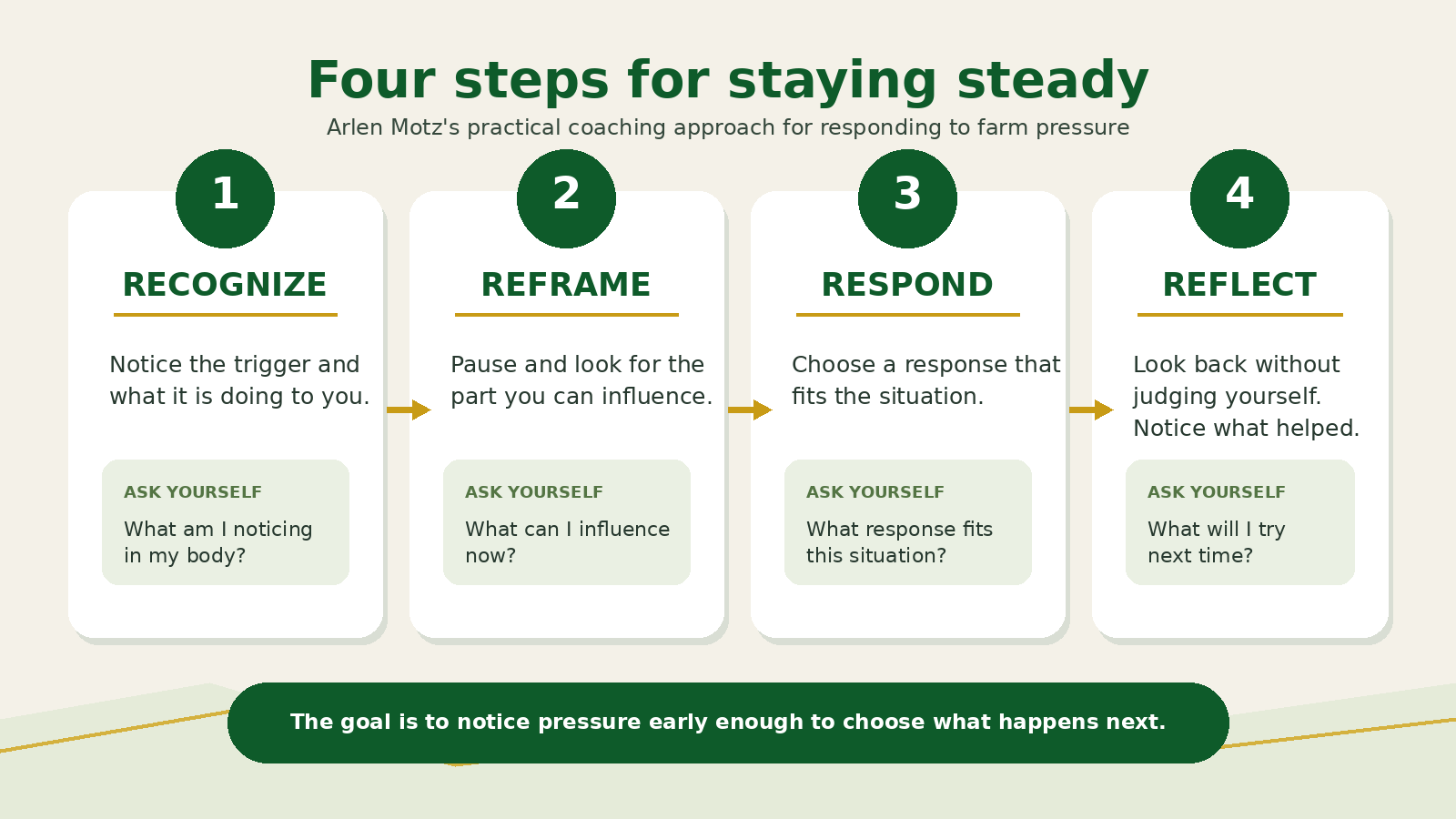
When we were conducting our research, we found so many lists, tips, and strategies that farmers could use to manage their stress. While all of them had merit, we found it difficult to present them in a coherent way.
That’s one of the reasons we appreciated Arlen’s approach — he provides a simple framework for understanding a fairly complex process.
Let’s break these steps down using a real example:
Imagine that a piece of equipment breaks down during harvest. You were told the replacement part would arrive on a particular morning. Great. But when you arrive at the dealership, the part isn’t there. You leave frustrated, knowing that the delay will affect the work, the people waiting on you, and possibly the crop.
Here is how Arlen’s four steps might look in that situation.
1. Recognize
Before deciding what to do, notice what the situation is doing to you.
Your jaw may be tight. Your thoughts may be racing through the time and money being lost. You might be replaying the conversation at the dealership and feeling an urge to call back immediately.
Ask yourself: What am I noticing in my body and thoughts right now?
Recognizing the reaction does not solve the equipment problem. It helps you see that you are carrying frustration into whatever happens next, whether that is a phone call with your spouse, a decision with an employee, or another conversation with the dealership.
2. Reframe
Take a moment between the reaction and your next action. Literally pause.
Reframing doesn’t mean you tell yourself the delay isn’t important. It means separating what has already happened from what you can still influence.
You might tell yourself: I can’t make the part arrive this morning. What can I do now?
Maybe you can ask the dealership for a clearer timeline, check whether another location has the part, adjust the day’s work, or let the people waiting on you know what has changed.
3. Respond
Choose a response that fits the situation instead of acting from the first surge of frustration.
You might take a short walk before making the next call. You could ask the dealership a direct question without repeating the full force of your anger. You might tell your family or employees, “I’m frustrated about the delay. Give me a few minutes, and then we’ll work through the options.”
The important part is having more than one response available.
Your reaction also affects the people working beside you. As Arlen puts it, “Leadership is more caught than taught.” Staying steady is partly about what you say, but it is also about what your response shows others when something goes wrong.
4. Reflect
Once the immediate pressure has passed, look back without turning the experience into a judgment about yourself.
Did taking a moment to pause help you think more clearly? Did you direct frustration at someone who was not responsible for the problem? Was there a question or action that helped move things forward? What would you try sooner next time?
Reflection also means noticing what went well. Maybe you avoided an argument, or found another option. Recognizing those moments helps build confidence for the next difficult situation.
Coping is a skill, not a personality trait
Arlen describes this work as a combination of skill and repetition. The four steps may feel deliberate at first. With practice, recognizing a trigger and choosing a response can become more familiar.
This is one reason coaching may appeal to some farmers. It can provide a practical space to work through decisions, communication, leadership, and recurring sources of pressure.
Coaching is not a replacement for mental health care when someone needs clinical support. It is one option within the wider space between doing fine and reaching a crisis.
Coaching and therapy can both help people respond to stress, but they serve different purposes. Coaching is generally goal-focused and action-oriented. It can help someone work on decisions, communication, leadership, habits, and how they want to respond in future situations.
Therapy is provided by a qualified mental health professional and may be a better fit when someone wants help with persistent anxiety or depression, trauma, grief, relationship difficulties, or patterns that are interfering with daily life.
One isn’t a lesser version of the other. The useful question is which kind of support fits what is happening now.
Farm life will continue to include uncertainty. Staying steady doesn’t mean handling every situation perfectly. It means learning to recognize when pressure is taking over, finding a response that serves you better, and carrying the lesson forward.
As Arlen puts it, part of the work is “owning the decision regardless of the outcome.” You may not control the weather, the market, the breakdown, or another person’s response. But you can become more intentional about where the stress goes next.

This story draws on work conducted for AgWell Alberta’s Staying Steady project, which explores practical approaches to farmer stress and coping.